Research topics
My research focuses on the development and analysis of numerical methods for solving inverse problems and for high-dimensional learning. It is motivated by real-world applications in image and data processing.
It combines tools from optimization, harmonic analysis, inverse problems, statistical learning, and scientific computing.
My work is driven by the desire to cover the entire development pipeline for solving a problem: from physical modeling to applications on real-world data, through the design of the method, its theoretical analysis, and its implementation on highly parallel architectures.
Inverse problems in microscopy
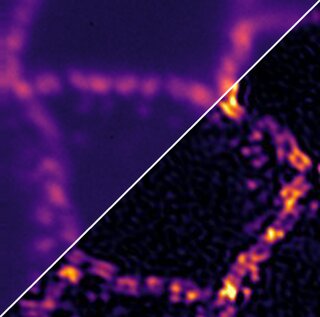
Images from fluorescence microscopes are degraded by spatially varying blurs, and the operators that model them are huge: up to \(10^{18}\) entries for a 3D volume. We develop fast approximations of these operators (wavelet and product-convolution expansions) and methods to estimate them from calibration images. We also build low-dimensional models of whole families of microscope operators, and neural networks that identify the point spread function directly from the data.
Inverse problems in photoacoustic tomography
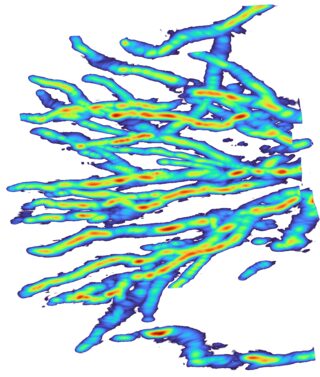
Photoacoustic tomography images optical absorption deep inside biological tissue with submillimeter resolution, by measuring the ultrasound waves generated by a laser pulse. Achieving high-quality reconstruction requires modeling the spatially varying impulse response of the detectors, which leads to operators that are hundreds of terabytes in size. We develop scalable GPU implementations of these operators based on the Green's function of the wave equation. We also work on fast non-convex reconstruction algorithms and on the calibration of the acquisition system.
Concentration of the minimizers of empirical risks
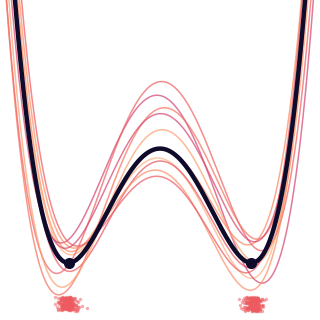
Machine learning models, from linear regression to deep neural networks, are trained by empirical risk minimization: we minimize the average loss over a finite set of samples as a proxy for the true (population) risk, which is unknown. Learning theory usually bounds the excess risk. In many problems, however, what matters is how close the minimizers of the empirical risk are to those of the population risk. We proposed a general framework, based on the local geometry of the risk around its minimizers, that gives optimal concentration rates for a broad class of problems.
JMLR 2024People
Postdocs
Florian Sarron (2026–2027), with P. Weiss
PhD students
Romain Bonnet-Eymard (2025–), with R. Bouclier
Image correlation based on physics-informed neural networks for the identification of mechanical property fieldsTrung-Thai Do (2024–), with C. Chaux
Large-scale reconstruction methods for high-quality 3D photoacoustic imagingCamille Ferrassou (2023–), with R. Bouclier, M. Duval and L. Risser
Construction of digital twins of military aircraft using robust machine learning techniques for monitoring mechanical aging
Master 2
Siyuan Li (2026), with B. Charlier
Dimensionality reduction for spatial omics data analysisSoa Durand (2026), with M. Costa and J. Fehrenbach
Transformation of a fluorescence-time signal into a DNA concentration-size distributionIyad Zekhnini (2025), with F. Iutzeler
Concentration of the geometry of empirical risksMaxime Lafont (2021), with C. Chaux and J. Gateau
A numerical method for fast 3D photoacoustic tomography with arbitrary geometry of sensors
Master 1
Hoai-Viet Dang (2026), with E. Soubies
Computational imaging with simple lensesTrung-Thai Do (2023)
Reconstruction methods for photoacoustic imagingTiphaine Vaisson (2023)
Calibration of product-convolution operatorsMinh Hai Nguyen (2022), with P. Weiss
Product-convolution neural networksMamadou Oury-Bah (2022)
Reconstruction methods for photoacoustic imaging
Funding
Ongoing
SO-LAR (2027–2030) ANR PRME, PI: P. Escande
SO – Landscape analysis of risksCLEAR-MICROSCOPY (2026–2030) ANR PRC, PI: P. Weiss, co-PI: P. Escande
Computational Learning for Efficient and Accurate Reconstruction in MicroscopyCRIPI (2025–2027) LabEx CIMI, PI: P. Escande
Calibration and Reconstruction methods for Inverse Problems in ImagingLASCAR-3D (2025–2026) CNRS MITI, PI: P. Escande
Large-scale reconstruction methods for high-quality 3D biomedical photoacoustic imaging
Past
MICROBLIND (2021–2025) ANR PRC, PI: P. Weiss
Blind inverse problems and optical microscopyEROSION (2022–2025) ANR JCJC, PI: E. Soubies
Exact RelaxatiOns for Sparse and low-rank optImizatiONCOCON 3D (2021–2022) France Life Imaging, PI: P. Escande
Co-conception of fast tomographic approaches for high-quality 3D photoacoustic imagingSPLIN (2021–2022) GdR ISIS, PI: L. Calatroni
SParse & non-convex optimisation approaches for data-adaptive Learning of INverse image microscopy problems